
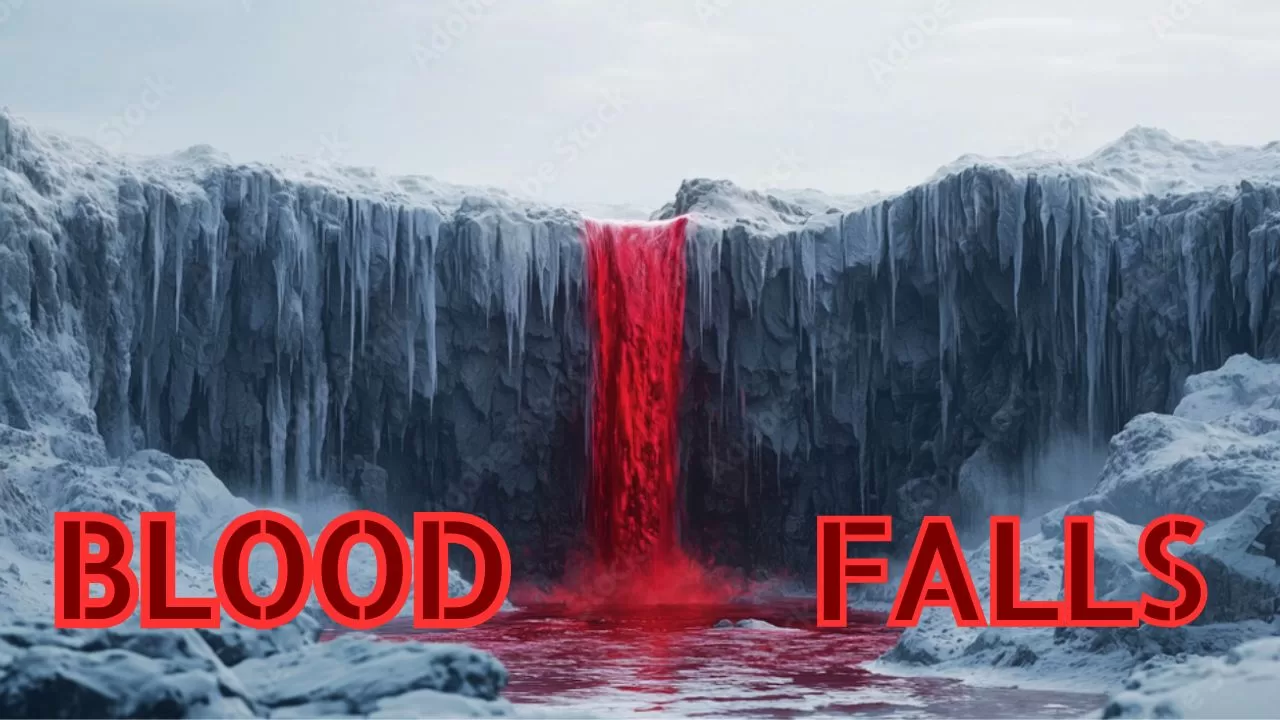
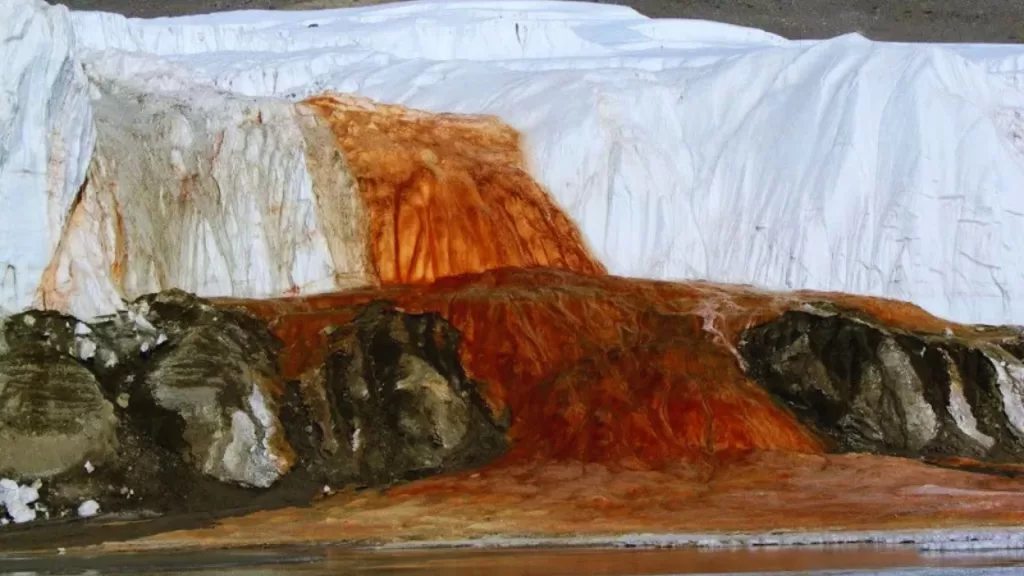
One of the most amazing natural phenomena is hidden within the frozen wilderness of Antarctica. A glacier with endless white ice in the background lets out a river of crimson-red water, giving it a sort of mystical appearance. This phenomenon, dubbed Blood Falls, has captivated explorers, scientists and mystery buffs for over a hundred years.
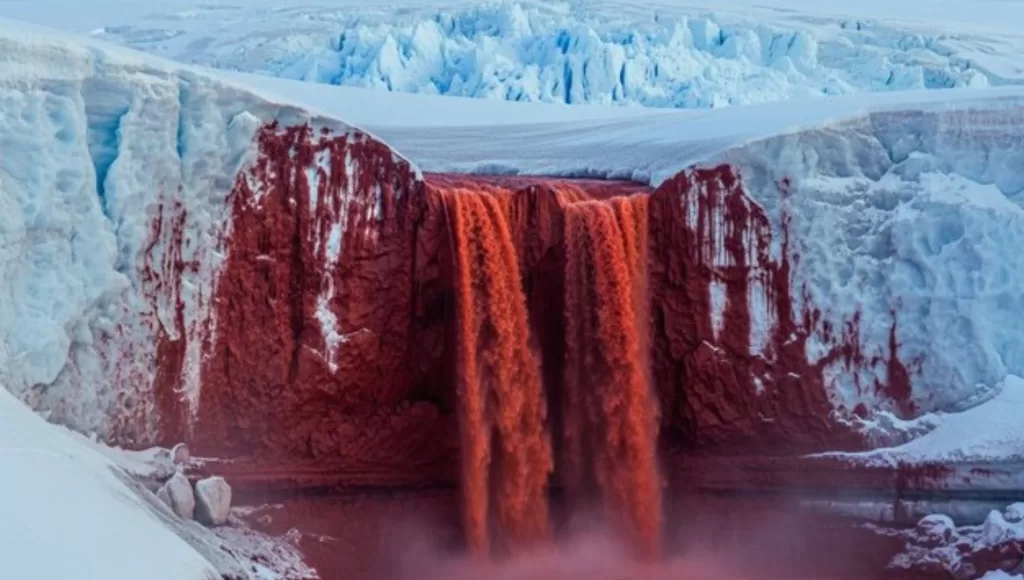
On the surface, Blood Falls appears to be a blood ooze from the glacier. The stain of the red colour is clearly visible on the ice and contrasts with the surrounding scenery. The only thing that could be said for many years was that the origin of the strange red liquid was not fully understood. The mystery raised many theories, from the presence of some unknown algae to some unknown geological process. Although much has been learned about Blood Falls by science today, it is still one of Antarctica’s most amazing natural phenomena.
Discovery of Blood Falls
Blood Falls is at the terminus of the Taylor Glacier in the McMurdo Dry Valleys of Antarctica. Australian geologist and explorer Griffith Taylor stumbled upon the falls in 1911 on one of the early expeditions to Antarctica.
Taylor and his team were amazed when they came across the bizarre red waterfall. However, at the time, scientists thought that the unusual colour was due to the growth of red algae inside the glacier. It was thought that this was a reasonable explanation as some microorganisms are known to produce a reddish pigment.
Over the decades, however, scientists’ methods became more sophisticated, and they grew uneasy about what was going on under the ice.
A Harsh and Isolated Environment
Appreciating the extreme environment in which Blood Falls exists is important to understanding Blood Falls. The McMurdo Dry Valleys are one of the world’s driest regions. Although situated in Antarctica, there is only a little snowfall and it is compared to a cold desert.
Temperatures are often severe and below freezing and strong wind blows moisture out of the system. They are very arid, like the surface of Mars, rather than an Antarctic environment.
In this frozen desert, the stretch of the land is taken up with the Taylor Glacier, which flows like a large river of ice. The enigmatic red flow spills from its face.
The Secret Beneath the Glacier
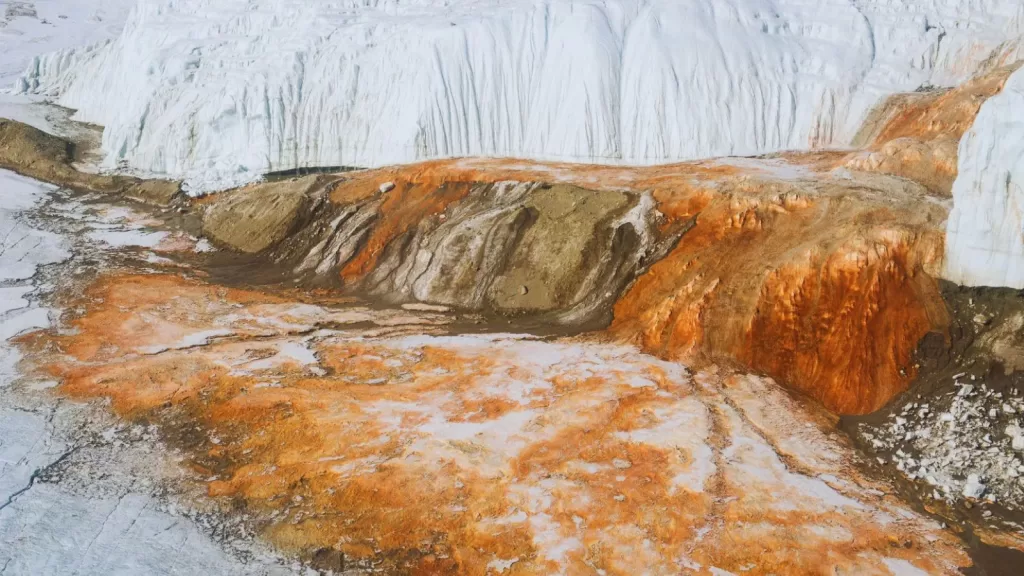
Recent scientific studies found that Blood Falls is the result of a hidden lake which is trapped under the Taylor Glacier. This subglacial aquifer is a chamber that has been under ice for millions of years.
The water of this ancient lake is very salty, in fact, much saltier than seawater. The liquid is able to remain in a fluid state because of its high salinity even at temperatures considerably lower than the normal freezing point of water.
It is thought that the lake was created when the sea-level rose to flood the region millions of years ago. The glaciers advanced and enclosed pockets of sea water under the advancing ice sheet. As the water was isolated, it increasingly became concentrated with salts and minerals over the years.
Sometimes this salty water is pushed up through a crack in the ice as a result of the pressure put on it by the glacier. At the end, when the liquid does emerge, it runs out of the glacier, resulting in the impressive formation of Blood Falls.
Why Is the Water Red
The science behind Blood Falls’ blood-like hue is pretty interesting.
Subglacial water has an extremely high level of dissolved iron. The iron is reduced when the water is underground and does not come into contact with a lot of oxygen.
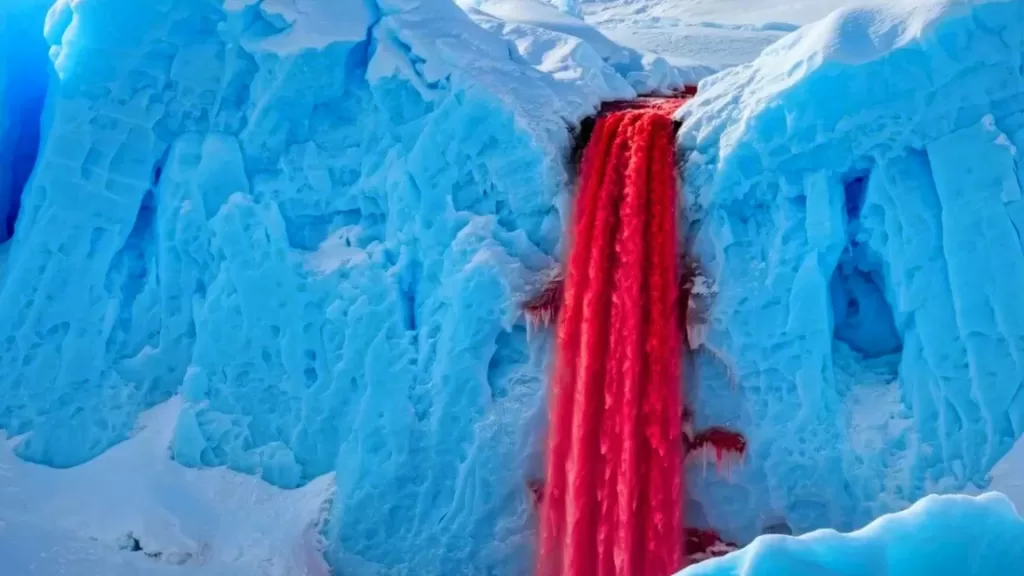
When the iron-rich water comes out of the glacier and mixes with the atmosphere, a chemical reaction takes place. Just as a piece of iron left out in the open to air and moisture will rust, the iron in the bag reacts with the oxygen and starts to rust.
This oxidation reaction forms the iron oxides which impart this distinctive reddish color to the water. In essence, Blood Falls is the result of a huge natural rusting process on the surface of the glacier.
The red streaks on the white ice are not blood, algae or pollution, but it is iron-rich brine that is oxidizing.
A Window into an Ancient World
Perhaps most interesting is that Blood Falls offers scientists a unique look into an environment never before accessed for millions of years.
For an extraordinarily long time the subglacial lake under Taylor Glacier, has been cut off from fresh air, sunlight and the outside world. However, scientists found micro-organisms living in the water trapped in it.
These microorganisms grow in the dark and do not require sunlight, they utilize sulfur and iron compounds. Such a way of life shows outstanding adaptability and upends the rules of living for survival.
Under the Taylor Glacier, the microbes have been a hot topic for scientists because they have the potential to provide clues to the existence of life in extreme environments in the universe.
Implications for the Search for Extraterrestrial Life
Not only has the Blood Falls gained the attention of geologists and biologists, but also astrobiologists.
The subglacial world under Taylor Glacier is a place of interest to scientists studying Mars and the icy moons of Jupiter and Saturn.
Other moons, like Europa and Enceladus are thought to have oceans under thick, icy crusts. The same kind of microorganisms could exist under the glaciers of other worlds, even if they receive no sunlight over the course of millions of years.
Blood Falls provides a natural laboratory for the research to be conducted to discover how life adapts to darkness, cold temperatures, high salinity and isolation—a setting that may also occur in the rest of the Solar System.
Solving the Mystery
For decades the origin of Blood Falls was a mystery because there were not easy ways to explore the interior of the glacier.
Eventually, newer radar-imaging, geophysical surveying and ice-penetrating technologies enabled researchers to map the network of channels that transport the briny water under the glacier.
Scientists employed some high-tech radar techniques in 2015 to verify the presence of a complex network of water moving underground from the lake to the glacier’s edge, carrying iron rich water. This finding was a validation of the modern explanations of the phenomenon.
Despite extensive learning, researchers are still studying the glacier and its unknown ecosystem. With every new finding, knowledge of the complicated geologic history of Antarctica is growing.
The Visual Impact of Blood Falls
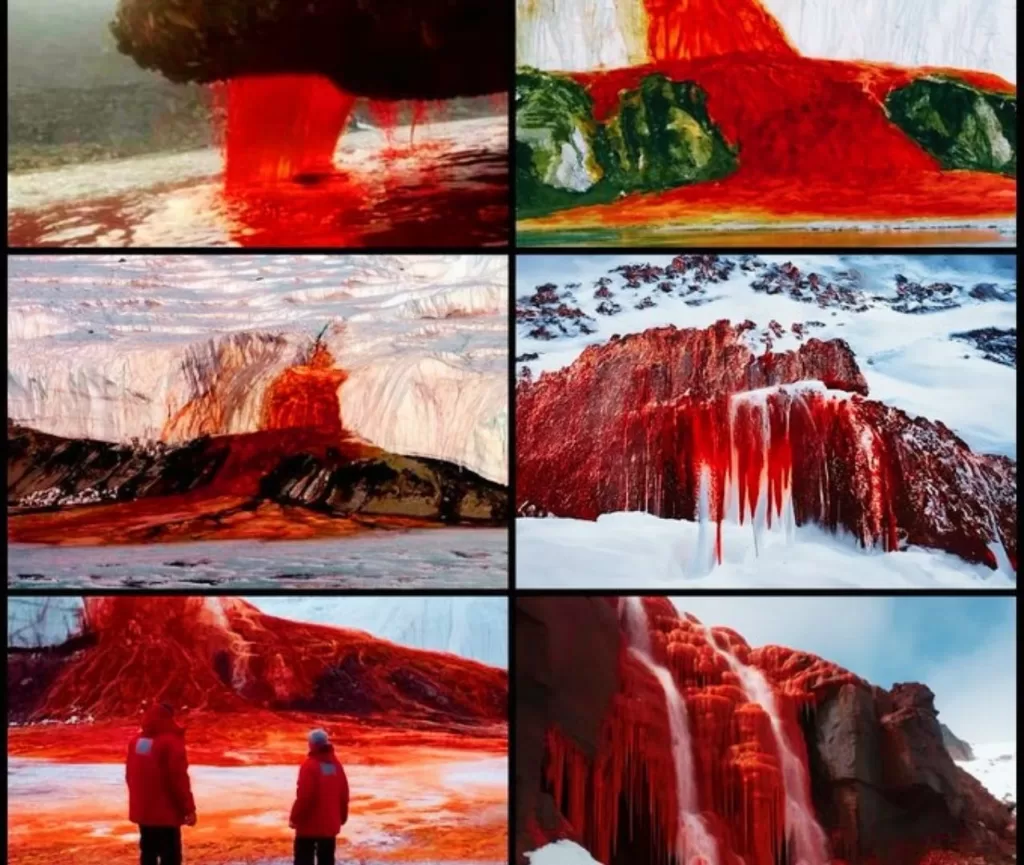
Blood Falls is also of great scientific interest, and it is one of the most visually spectacular natural phenomena in the world.
The pictures of the falls frequently cause people to be amazed. Bright red liquid pouring out of a frozen glacier, it seems like a dream, a sci-fi movie, instead of reality.
The colors of crimson stains and the white ice on the background are so different that the scene is never forgotten by anyone who witnesses it.
Given its remote location, not many people will ever get to see Blood Falls in person. However, photos and documentaries have helped to make it one of Antarctica’s best known landmarks.
Conclusion about Blood Falls
Blood Falls is an extraordinary example of the Earth’s mystery waiting to be discovered. Once thought to be a glacier trickling down the Antarctic earth, it is now known to be a geology, chemistry and biology phenomenon.
The hot, iron-rich brine that is bubbling up through Taylor Glacier holds the clues to a hidden ancient ecosystem beneath the glacier that extends back millions of years. Meanwhile, the microbes growing in this environment in isolation can reveal to us the boundaries of life and the potential for life on other planets.
Today, much of the mystery of Blood Falls has been solved, but its appearance and marvelous origins continue to inspire wonder. This crimson waterfall is one of the most captivating spectacles of nature in Antarctica, where the frozen landscape shrouded in silence and endless ice and snow makes it a mysterious and scientifically intriguing destination.





0 Comments